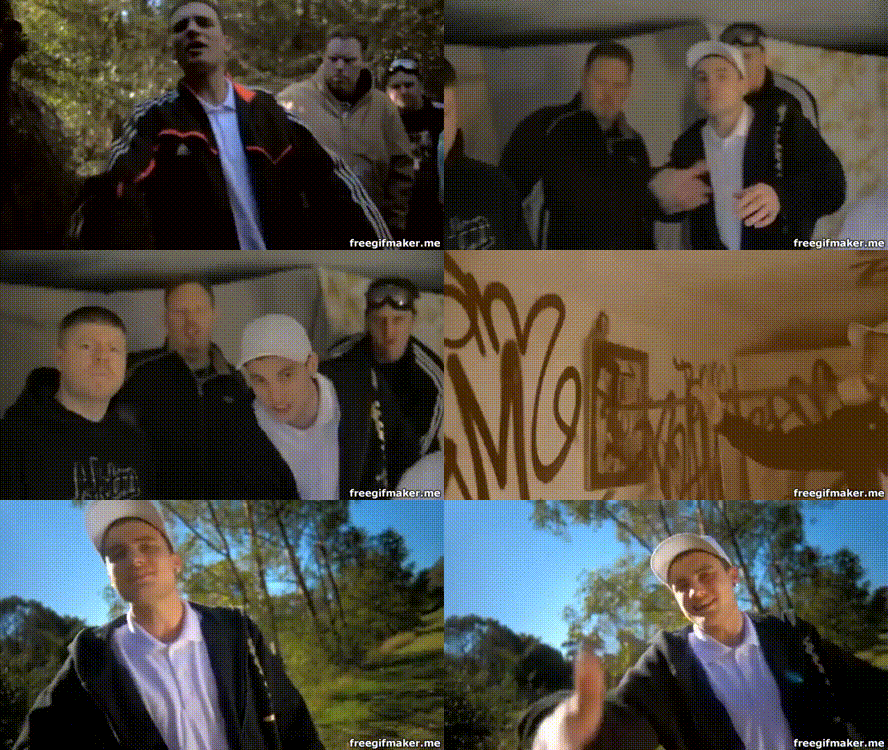
DM'ing with BBG Smokey from 66Records

Last week I made a post about 66records and why I think they have the potential to be one of the biggest forces in Australian hip hop. Melbourne is due for a new movement and artists like Gs Phantom, Pronto and BBG Smokey are bringing a new voice to the forefront of Melbourne hip hop. Just like I touched on in my last post, African Australian representation in hip hop is well overdue and today I had the pleasure of speaking to one of my favorite artists in 66Records, BBG Smokey.

In my short conversation, the South East Melbourne native had a lot to say about African Australian representation in Aus hip hop and what 66records was doing to change the landscape of hip hop in Australia.

follow Smokey @xdarealbbgx


First off where in Melbourne are you from and what was your upbringing like?

I'm from Frankston originally, I was raised on the streets.

What are your thoughts on hip hop in Aus at the moment?

I feel like hip hop isn't really appreciated here in Australia the industry is Fugazi

The people behind the scenes like the big industry people don't really know what hiphop even is.

I hear heaps of youngboy and A boogie influence in your 'only one' track, do you mainly listen to American rappers? 

Yeah I listen to music that's similar to how I live my life, it inluences me. NBA Youngboy is an example of that

No doubt, it's only recently  I've really been hearing African boys doing their thing in Aus, why do you think that is? Do you think 66records has alot to do with that?

That's exactly what 66 is achieving and the reason why it started. 66Records see how the industry is and are trying to change that. Putting on talented artists that might never get the chance without the label.

Do you think the industry has ignored African rappers?

Certainly, African rappers aren't given the spotlight that they deserve.... I'm not talking about just any African rapper that reckons they are an artist but the ones that are actually talented and have potentially bright futures, it feels that the industry is trying so hard to ignore that.

Well if 66records keep doing what they doing i don't think it's gonna be like that for much longer.

Yeah that's a fact.


Are there any artists in aus you fuck with outside your team?

I fuck with anyone that's doing them, anyone that's trying to make a living through music and someone that's talented, obviously.

What does the future look like for you? what have you got coming this year?

Album this year

National tour

More videos


The Rise of 66records

I have to say, of all the countries with a hip-hop scene Australia has got to have the least amount of Africans which is kinda surprising seeing that most scenes whether it be the US, UK, France,  or Canada, all these countries biggest rappers are black. For most Aussies, if you ask them to name you an African rapper they'd tell you Ur Boy Bangs. Who, before you laugh, is one of the most viewed rappers in the county, appeared in a KIA ad, was the first Aussie rapper on Jimmy Fallon, and in my opinion, a pioneer in the sound Lil Yachty made popular. (he also made all his beats). I know it's probably going to impossible to convince people Ur Boy Bangs is an underestimated artist/producer/entrepreneur/mogul so that being the case, there isn't really any notable African Australian artists. With almost 400,000 Aussies with African heritage, it really is surprising that there hasn't really been a proper lane for African Australians, of course, there are a few artists like Manu Crooks out of Sydney, but these artists are far and few. When you say African Australian a lot of people will think of Melbourne, home to a large number of East African Australians and the notorious gangs made popular by the media like Apex Predators. It's in these streets of Melbourne that 6 years ago a record label was born that would focus on African Australian artists, 66Records. 66Records is shrouded in controversy, one of their events in late 2018 caught media attention when a brawl broke out leaving 7 hospitalized and the record label was even featured on Four Corners ABC. Beyond the controversy, 66 records are producing top quality music videos covering all styles of hip-hop.


I'm not going to lie, the first time I stumbled upon 66Records I thought it was just B-grade American rip-off music that wouldn't catch on.
But after a couple returns and some new discoveries, my opinion made a 180-degree shift. Although the American accent is still there, which 99% of the time doesn't work and isnt memorable, I found that some of the 66records tracks were pretty catchy and even with the accents could stand up to any Aussie tracks id heard and even lots of the stuff coming out of America. The first track from 66Records I really fucked with was BBG Smokey - Only One, the song is clearly heavily influenced by NBA Young Boy from Louisiana and the Visuals could be straight out of London. The song and the visuals were well produced, catchy and had a laid back vibe to it, I thought it did a pretty good job at capturing the energy of the African Australian experience in Melbourne. Now don't get me wrong ALOT of the videos on 66Records are American look-alikes that are mediocre but there are some proper gems on the channel. Pronto - One Day is one of these gems that is super catchy and feel good, I remember playing this with some mates and it was a great song to just kick back too. Both Pronto's One Day and BBG Smokey's Only one are fairly new and hopfully a sign of whats to come. I can totally see 66Records dominating the Melbourne scene in a few years. I think the next step for 66Records is to just maintain the consistent uploads and maybe even reach out to others in the scene, I can totally see a BBG Smokey and Kid Laroi collab.


UK influence in Australian hiphop

Hiphop is  a funny thing, it is the most black American art form there is but it's a global phenomenon. The black experience and hiphop are almost inseparable, so when hiphop spreads to somewhere outside of America it almost always maintains an Americaness to it. The UK, one of the early adopters of hiphop was no exception from this.  Although the UK had a connection to hiphops founding city New York through both cities having large Carribean and west African communities London still had a long journey to finding its own identity. 1980's Uk rappers like Dizzy Heights were almost indistinguishable from US rappers of the time. The 90s brought the Uk abit more identity with the popularity of jungle and garage music, but that wasn't even considered hiphop! 2000's birthed Grime, the first truly British sub-genre of hiphop with household names coming from this new scene like Wiley, Dizzee and Tinie Tempah. This early period in grime even had an effect on Australia with the arrival of Fraksha from England and his formation of Smash Brothers, the first Grime crew based in Australia.
Dizzee and Wiley
By the late 2000s Grime in the UK would die down and be replaced by more American styles, Grime crews in both the UK and Aus would remain underground and local. In this dull time both Brits and Australians still looked towards America for the new trends, until 2012. There is no exact date but I like to pin it to Skepta's Ace hood flow music video, this, for me at least, was the start of the Grime renaissance. The following year would see an explosion in Grime with old artists like Skepta, JME, Kano and Wiley making massive comebacks and new artists like Stormzy and Section Boys finding new success. This 2nd wave of Grime was different to the first in the early 2000s because it had a global impact with UK artists finding die-hard international audiences in the US, mainland Europe, Canada, New Zealand and Australia. The Grime comeback peaked in mid-2015 with the release of Stomzy's park freestyle 'Shut up' and Skepta's long-anticipated video for 'Shut down' which even had a cameo from the worlds biggest rapper Drake. This period was so massive for the UK scene that they probably will never again look to America for trends, the biggest artists in the UK are from the UK. New genres came out of this time like Uk Afrobeat and Uk drill the latter of which has seen some success in Australia too.

With the arrival of Uk artists to Australia through tours and festivals, it seemed clear that this new British resurgence would rub off on the Aussie scene. It was possible to create a hiphop scene that was almost 100% true to the culture, there was finally proof, a blueprint. Of course, there has been grime acts in Australia since the arrival of Fraksha like Thats Them crew from Sydney, Alex Jones and Mr Wrighty;shit, no one should forget the time Kerser jumped on a grime track with Thats Them.
By 2018 the kids that were around during the grime explosion of 2014 were older and drew fashion and music influences from the UK.
Artists like Shadow, Chillinit, Wombat and Hazrd were all giving grime a go, and it was working. But with this new found success many were questioning if the scene was going backward, that we weren't going our own way but just replacing America for England, and can you blame them? For so long Grime had been an exclusively British style and for some, the accent change just didn't work. Others pointed to groups like One Four who were criticized for completely ripping off UK drill. In an interview with WDE One Four member YP said that they were heavily influenced by Uk drill rappers because they live like them. The succes of acts like Chillinit, Wombat and One Four can be largely owed to the rise of UK influence in Australia and more interest in that style, and while som critics say it's a generic bite of the UK style it's undenyable that it's had a positive impact on the growth of Aus hiphop.


Has Chillinit pushed Australian hiphop into a new era?

In August of 2018 the popular UK youtube channel, JDZ Media released its first-ever Australian clip, a live spit by Sydney's very own Chillinit. With over 380,000 subscribers this is the biggest feature an Australian artist has had on a UK youtube channel and only the second time i can recall an Aussie artist even being on a UK channel (the other being Alex Jones). To make things even better the video is one of JDZ media's most popular uploads this month, even getting a comment from popular artist Izzie Gibbs. There are more and more UK fans turning their gaze to the Australian scene and Chillinit is leading the charge. The last 6 months have really been Chillinit's moment, 2 of his videos reached a million views, sold out nationwide tour and just recently a UK feature. I was at the Bodybag tour in Sydney, it was a coming together of most of the new generation of the scene, it was amazing to see the type of energy Chillinit and the crowd could create. I had never seen these types of fans at a Sydney show.


 The thing I find so cool about Chillinit is the work rate and the way he is able to increase the work rate of those around him, in a West Enders interview Wombat talks on how Chillinit 'G'eed him up to make more tracks'. This is exactly the type of people I think we need to bring us into a new era of Australian rap. As much as Kerser did alot for the scene I think he missed a really important opportunity by not shining a light on other talent and not cooperating with other artists. Kerser was much more focused on himself then the scene. I think artists like Chillinit are throwing away this lone wolf mentality and actually working for the scene and not themselves. This is what I mean by Chillinit pushing Australia into a new era. When I look over at the UK and the progress they have made in the last 5 years it all seems to come down to unity, cooperation, and talent.


.

How Hustle Hard Tv redefined West Sydney

This was actually my first ever post back in 2017 which is nuts that this things existed that long.

 As we sit on the eve of 2020 it's looking like the 20s is going to be a really formative decade for our scene, I have a feeling it could be to us what the 90s was to America and the 10's was to the UK. I'm leaving the bulk of this the same - so ignore the weird structure of it all - , i just thought it would be cool to tweak this a bit for 2019, also,barely anyone read this the first time it went live.  This could be my last post of the year on my little blog, I've been writing on www.thewestern.com.au so go sus that out if you wanna see what a write like when I actually have to do a few drafts. 


Sydney has always been a divided city, east and west, north and south, city and suburb. The divide has shaped the dynamic of many subcultures and this rivalry seems to be perfectly highlighted in the story of Australian hip-hop. The west has been home to Sydney's working class since the city's establishment - whether it be  the original slums in the inner west during Sydney's infancy, or modern-day TV shows like Struggle Street putting a spotlight on poverty in Mount Druitt -  it's safe to say that the West has always had a reputation for poverty and crime. The East-West rivalry is more than just a petty feud, it encapsulates two different ways of thinking, urbanite vs suburbanite  and opportunity vs lack of opportunity.  

When hip-hop arrived in the 80s most would have assumed Western Sydney to embrace the art form that had traditionally been an expression of the poor. Apart from some early contributions in hip-hop and graffiti, Western Sydney's commercial success in hip-hop has been lacklustre and no artist has seen much mainstream success until the last few years. For a long time Australian hip-hop had struggled to tap into working class audiences. In my opinion, this is due to lack of accessibility. Before the internet, it was the kids in the city who had the hip-hop shows, had graffiti stores in their areas and even interacted with guys from the States or the UK who were rarely seen in Sydney's west. This brings me back to one of the main elements of our West-East rivalry, the imbalance of opportunity between the two sides of the City. The Sydney scene was in an awkward position - a genre that had generally been reserved for the poor was being championed by upper-middle-class kids. Successful acts like Horrorshow and Bliss n Eso weren't from particularly rough backgrounds, and this is no fault of their own because there was clearly a market for what they did, but as a consequence their movement lacked an energy, an energy that's hard to replicate, the energy of the working class. Of course, there were known acts from the west, one of Australia's very first hip-hop collectives, Def Wish Cast was from the west, Hyjak and Torcha were also known in hip-hop communities around the country (even if they did stay  underground their whole career). What I'm trying to say is that arguably the birthplace of Australian hip-hop, Western Sydney, was not seeing the same success of east London, northern Paris  or the Bronx - these areas became synonymous with hip-hop culture so why wasn't West Sydney being treated the same within Australia? why was the industry ignoring the west?

Def Wish Cast 1993
The Internet changed the way we consume music and interact with artists, no longer were the radio, television, and magazines the gatekeepers of music. Anyone could discover the most underground of artists from the comfort of your own home. The growth of the internet resulted in the decline of traditional media's grip on what youth consume. Throughout the 2000s, the internet started to play an increasing role in the dynamic of hip-hop scenes around the world. Nowadays it's hard for us to even imagine hip-hop without the internet.
The rise of the internet had finally brought in a sense of balance in our city when it came to opportunity - it didn't matter anymore if you couldn't make it to the local hip hop event, or you couldn't network with the right people, all you needed now was an internet connection to make your voice heard.  Youtube channels and websites started to pop up around the world, basically, every hip-hop scene had its own corner on the internet - big or small. 2005 saw the birth of WorldStarHiphop it soon became the dominant player in online hip-hop in the United States - similarly, SB:TV was born in 2007 and became the number 1 hip-hop channel on youtube in the UK with other titans like Link Tv and GRM Daily soon to follow. All this to say, by 2010 the internet was the main medium that youth used to interact with their favorite artists and it wasn't long until Australia would see a similar sort of online outlet.


On November the 7th Hustle Hard Tv was created and changed Sydney hip-hop forever. Our own little corner on the internet had been established. Ten days after its inception the channel uploaded Gravy Baby's first ever clip, 'what it is'. The music video suffered a symptom many young hip-hop scenes outside the States suffer, a forced American accent. Excluding the accent, the video was as Western Sydney a  video could possibly be and the hood styled video format was the perfect recipe for a successful Western Sydney based hip-hop channel - for Westies, by Westies. 


Gravy Baby- What it is
Thankfully it wasn't long until a lot of the rappers on HHTV shook off their American accents and embraced their own slang . Gunsta, the creator of HHTV, was doing what hadn't been accomplished in Sydney, consistent uploads, regular rappers and an openness to posting new rappers or artists outside of Sydney. Within a couple of years, HHTV was able to establish itself as the one stop shop for DIY  clips and it was unapologetically  Australian. This was the kickstart the Aus hip hop scene needed. It's no surprise that the rise of HHTV was met with opposition, the term 'gutter rap' was the popular label used to criticise the new style of production, especially in the East. Ironically the term 'gutter rap' was embraced by many in the sub-genre who almost preferred not to be grouped with the traditional, inner-city, feel good hip hop that had been the main style during the 2000s.By 2012 artists like Gravy Baby, Nter and Kerser were racking up hundreds of thousands of views, their songs could be heard playing from mobile phones at parks and train stations all over Sydney. The Sydney hip-hop landscape was barely recognisable from 10 years earlier. 


Kerser Vs 360 
One of the biggest boosts to what most were now calling 'gutter rap' was the 360 vs Kerser battle, I won't get too into it now, but it was such an interesting time in Australian hip-hop, in short, it was the perfect battle; Sydney vs Melbourne, working class vs middle class, metro vs lad, it seemed like the final showdown between the two factions of Australian hip-hop. Everyone was talking about it and everyone had a favorite of the two. As of now the battle has 3 million views on youtube which is high for battle rap standards, even in the States. The battle introduced a lot of people (especially those outside of Sydney) to 'gutter rap' and the battle legitimized Kerser as a big player in Australian hip-hop. The release of Kerser's debut album The Nebuliser saw an end to his collaboration with Hustle Hard. His nation wide fan base gave him the opportunity to start up his own youtube channel. The Nebuliser was a huge success, it was followed up by the Nebulizer national tour, where many Hustle Hard TV artists supported Kerser on stage and were able to get a feel for what professional rapping is all about. Kersers departure from Hustle Hard Tv was not the end of the HHTV story, many artists on the channel had strong fan bases and could count on their videos getting hundreds of thousands of views, consistently. Together, Nter and Gravy Baby would take the reigns as the stars of HHTV. Whenever they came together they were able to almost effortlessly create Sydney anthems. Gravy and Nter's two big collaborative tracks 'Holy Water' and 'My City' have 5 million views between them, and that's not counting the millions of times they've  been played as downloaded tracks offline. 


Nter- The Return

As it stands right now HHTV  has uploaded over 500 clips and has amassed over 38 million views. HHTV is the most successful Australian hip-hop outlet by far. It's been a launch pad for dozens of MC's in Sydney and proved that success is achievable without a label or budget. HHTV introduced the blueprint for artists nationwide.Over the past few years it seems like the success of HHTV has started to slow down, but this in no way signifies a slow down in the growth of Sydney hip-hop as a whole. Many rappers from Sydney have seen what Hustle Hard achieved and are following the blueprint, just more independently. Hustle Hard